An Air India plane crashed on June 12, with a death toll of over 240 passengers. The plane crashed into B.J. Medical College and Civil Hospital in Ahmedabad, India, leaving a single survivor.
🕒 Read Time: 5 Minutes
June 14, 2025 | Dispatch | Power and Security
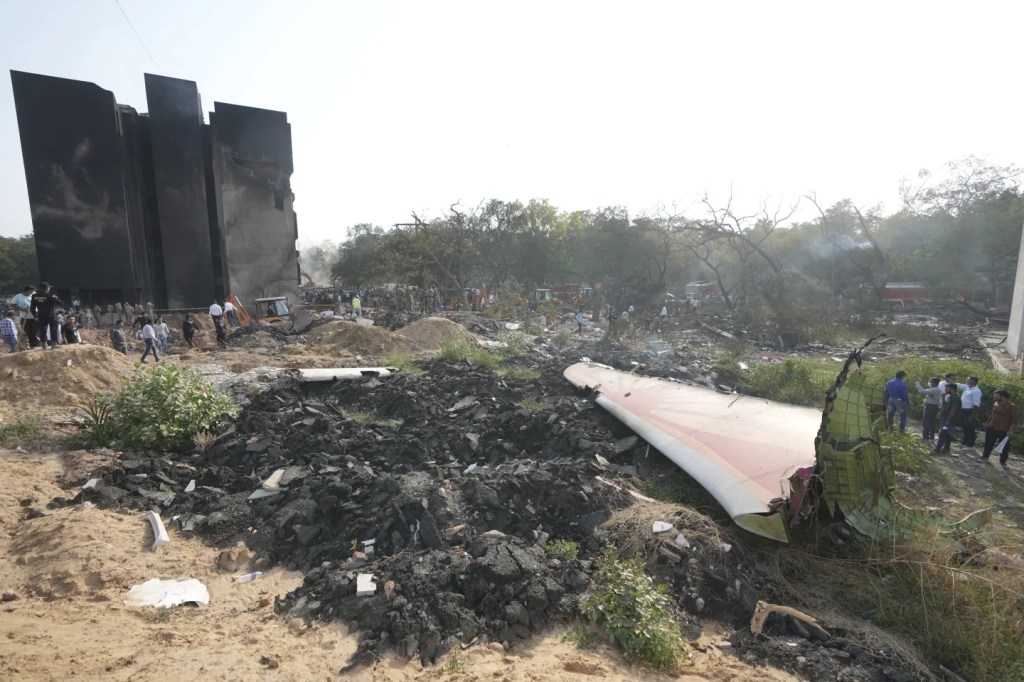
Air India Flight AI171 was on its way to London before it crashed into the medical college, killing two students and injuring over 40 others. The official total number of casualties, separate from the people on the airline, has not been recorded; however, it is estimated to exceed the official count.
Vishwashkumar Ramesh, the sole survivor of the crash, gave an account of his experience on the plane. In a statement relayed by a medic and documented by the Associated Press, Ramesh explained that the plane “began descending and suddenly split in two, throwing him out before a loud explosion.”
The cause of the crash is being speculated by many, but has not yet been determined. Preliminary speculation over such causes includes engine failure or bird strike, but authorities have not confirmed anything.
Air India experienced its most recent major tragedy in 2010, when Air India Express Flight 812, involving a Boeing 737-8HG, overshot the runway on arrival and crash-landed into a hillside, killing 158. Another incident occurred in 2020, when Air India Express Flight 1344, also operated by a Boeing 737-8HG, skidded on the runway during a severe rainstorm, splitting open and killing 18.
Air India Flight AI171 was flown using the Boeing 787 Dreamliner, the newest Boeing model, surprising many with the model’s first crash since its debut in 2011.
Air India was founded by the Tata family in 1932 as Tata Airlines. However, India seized control of the airline to govern domestic and international flights in 1953.
From 1953 to 2022, Air India suffered from inefficiency in management and outdated processes, leading to an accrual of $8 billion in debt. The Indian government set up an auction for the company in 2020, hoping to attract foreign investors to the bidding.
This allowed the Indian government to use the company as a scapegoat for the state’s economic backsliding. However, the airline itself suffered due to the lack of maintenance and fiscal appropriation.
When Tata Sons took over the company, the market share for Air India was at 12%, with a minimal amount of fiscal investment into maintaining the company. With such poor management of the airline by the Indian government, the company lost key investors and suffered under an increase in private sector competition.
Tata Sons has committed to working on rebranding the airline, as well as establishing strengthened relations with Boeing, though responsibility for the crash has yet to be determined.
Regardless, accountability is extremely important to ensure that this issue does not persist, prompting an international investigation into the matter.
The investigation must include an in-depth analysis of contributing parties, such as Tata Sons, the Indian government, and Boeing. It is crucial that this investigation brings to light any potential cracks that historical inefficiency and crippled development may have opened up in Air India over time.
 The Diplomatic Drift
Leave a comment