🕒 Read Time: 15 Minutes
May 26, 2025 | Historical Review | Global Governance and Diplomacy
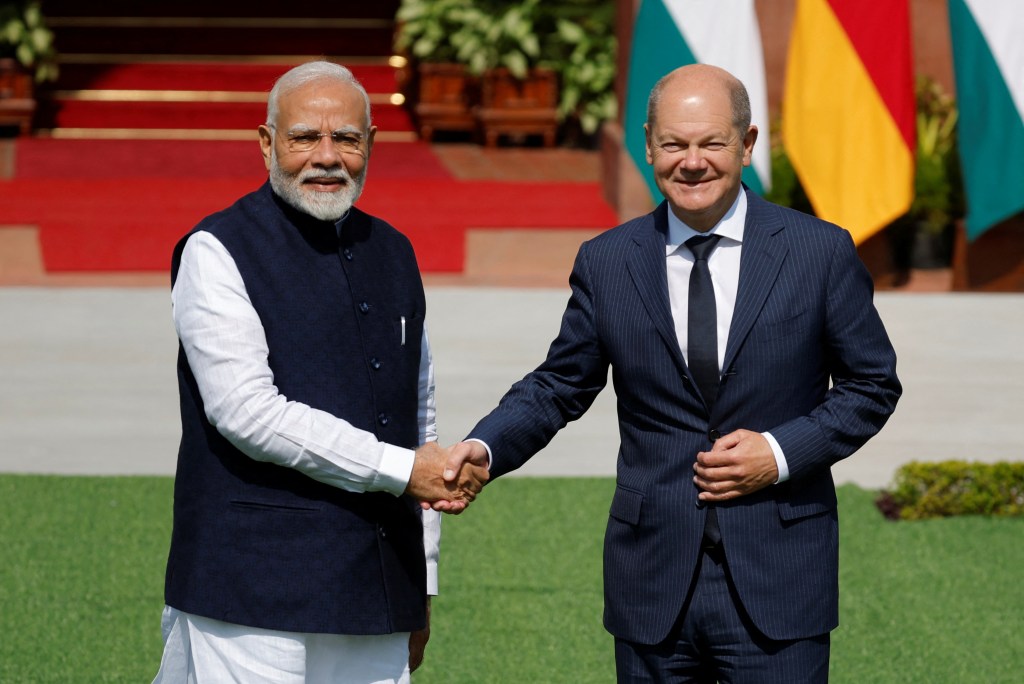
India and Germany have a similar upbringing, rising from the ashes of World War II and implementing democratic governance. Before the war, India and Germany had limited interaction, both states constrained by British imperialism and Nazi Germany, respectively.
Although both states had troubled upbringings, this piece will examine Indo-German relations through the simultaneous rises of these states, the rise of relations between these states, and the contemporary status of Indo-German relations.
India and Germany: Rising from the Ashes
To completely understand the direction that India and Germany took in establishing foreign relations, it is crucial to explore how both states came to be in a position capable of establishing such relations.
Origins of Britain in India
Britain, in 1858, gained complete control over India as a result of the Indian Mutiny of 1857 against the former reigning party, the British East India Company. During the Indian Mutiny of 1857, Britain completely overpowered India, with its powerful weaponry and the mutiny occurring at a time that scholars argue was an “incontestable British hegemony.”
The aim of the mutiny was to completely expel Britain from India; however, the mutiny was a complete failure of the Indian independence movement, ending in strengthened British reign over India, ultimately leading to the establishment of the British Raj.
Over time, British rule over India legitimized with the appointments of several viceroys to exert a certain amount of control over India on behalf of Britain, but in the years following 1900, the British Raj began experiencing the beginning of its 50 years of steady decline, with the eventual Morley-Minto Reforms in 1909 allowing for an increase of Indian representation in the British government.
With the increase of Indian political representation in the wake of a rise of Indian nationalism, these reforms would mark a grave British mistake.
The Fall of the British Raj and Indian Ascent
India began to truly gain political traction from 1910 to 1920, with British inclusion of India in political conferences such as the Imperial War Conference in 1917, a reward for unwavering Indian support for Britain in World War I.
A major shift in the Indian nationalist movement was the British entrance into World War II. Throughout the war, Britain held on to its control over India, even as Germany, Italy, and Japan made offensive efforts against the Allies. During the war in 1941, United States President Franklin D. Roosevelt met with Winston Churchill, the Prime Minister of Britain, and together they signed the Atlantic Charter. This charter ironically declared the wish to grant all people the right to choose their own government, declaring both the U.S. and Britain’s opposition to imperialism in Europe.
As a result of this, the Hindu majority Indian National Congress passed its “Quit India” resolution, calling for the dismantling of the Raj. This marked a pivotal point in the Indian independence movement, citing the charter for leverage against British imperialism.
The Allies eventually won the war in 1945, leading to an even stronger fight for Indian independence. This resulted in an increase in dialogue between the Indian National Congress and Britain pertaining to India’s freedom. This showed the successes of these efforts and the inevitability of Indian independence. However, due to the Hindu majority Indian National Congress expected to be the ruling party of an independent India, internal division between Hindus and Muslims in India increased. The proposed solution to this issue became known as the Partition of India in 1947, developed by the most recently appointed Viceroy of India, Lord Louis Mountbatten.
Nehru, the leader of the Indian National Congress, did not approve this partition, due to his belief that Hindus and Muslims could still be amicably reconciled under a singular Indian government. However, due to Indian aspirations for independence at any cost and the communal violence developing between Hindus and Muslims in India, his concerns were disregarded.
On August 15, 1947, the Indian Independence Act of 1947 was signed, officiating the partition of Indian provinces Bengal and Punjab, establishing East and West Pakistan. This signified the end of British rule in India, delivering India with the autonomy to conduct itself freely.
Rise of Nazi Germany in 1933
In January 1933, Paul von Hindenburg, the President of Germany, named Adolf Hitler to be German Chancellor, marking the beginning of a very dark period for Germany.
Hitler claimed enormous power as Chancellor, as he, together with the Nazi Party, committed several atrocities against anti-Nazi parties and out-groups in Germany.1 After the Reichstag Fire in 1933, the party banded together to announce its mission to combat communist power and attack its out-groups, with Hitler declaring that “‘There will be no mercy now. Anyone who stands in our way will be cut down’.”
The Third Reich, the period of Nazi rule from 1933 to 1945, became marked by the extreme views that Hitler installed into Germany. The party’s anti-Semitic attacks on Jews and its violence toward anyone against the party embodied these views.
Hitler eventually transitioned beyond domestic control, by declaring World War II in 1939 to move forward with his territorial ambitions for Germany.
End of World War II and Nazi Defeat
World War II, from 1939 to 1940, was a period of extreme violence consisting of invasions and airstrikes by Germany against European nations.
Germany made territorial gains in Europe, invading and capturing nations such as Poland, Norway, and Denmark. In 1940, Germany made a “Pact of Steel” with fascist Italy, forming an alliance with the Dictator of Italy, Benito Mussolini. Germany eventually made its way to France and Britain, launching the infamous “Blitzkrieg,” causing heavy damage to both nations. The result of successful German offensives in Europe, and the Japanese attack on Pearl Harbor in 1941, prompted the United States to enter the war and aid the Allies.
Leading up to 1943, the Allied forces made steady defeats of Germany, Italy, and Japan. In 1944, after successful counteroffensives against the Axis powers, the Allied invasion of Europe, historically commemorated as “D-Day,” commenced. The invasion was a success, with the U.S., Britain, and France defeating Germany in the West, and the Soviet Union engaging Germany in the East. This led to the defeat of the Axis powers in 1945, sealed by the drops of the U.S. atomic bombs in Japan and Hitler’s surrender by suicide, eventually resulting in the Potsdam Conference for peace.
Germany was divided up between the Allied powers, with “Great Britain in the northwest, France in the southwest, the U.S. in the south, and the Soviet Union in the east.” As a result of the war and the Potsdam Conference, the Soviet Union expressed its desire to maintain its territorial acquisition in the East, establishing a continued presence in Germany by developing communist East Germany’s German Democratic Republic underneath its control.
Reconstruction ensued in both East and West Germany, with a large amount of financial support from the West to ensure the continuation of relative stability in the nation. However, West Germany, in contrast to East Germany, was established as a democratic state without the presence of imperialist control and became known as the Federal Republic of Germany led by Chancellor Konrad Adenauer.
The Rise of Indo-German Diplomacy
India and Germany post-World War II both had time to develop their respective nations and manage their states’ diplomatic efforts. Although it was not an instant success, relations between India and Germany took form after the war, providing a stable foundation for what was to come.
Genesis of Indo-German Relations
Jawaharlal Nehru and Konrad Adenauer became the leaders of their state governments after World War II, both tasked with the rejuvenation of India and Germany, respectively.
In terms of state reconstruction, Nehru and Adenauer had differing views on how they would go about this. Nehru was motivated to industrialize India to stimulate its economy, previously disallowed by British control. In contrast, Adenauer prioritized a social market approach to the economy, while retaining close ties with the West. However, both leaders recognized the importance of building strategic diplomatic ties with each other.
The two first established relations in 1951, after Adenauer re-opened the German Foreign Office and selected a German Ambassador to India, Ernst Wilhelm Meyer. Meyer was an experienced diplomat with a similar worldview as Nehru, with a devotion to developing strong and long-standing relations with India. He was known for his rejections of certain proposals or orders from the West German government, due to his fear that they would strain relations with India. His time in office is known to be the reason for the positive first impression on India that allowed for relations to healthily proliferate.
Parallel to Adenauer, Nehru subsequently also appointed an Ambassador to Germany, Arathil Candeth Narayanan Nambiar. Nambiar spent much of his life in Germany, serving the Indian independence movement in Europe while working to deepen his understanding of the state. He generated several German and European connections during his time in Germany, allowing him comfort in his newly appointed diplomatic position.
The appointments of ambassadors and the mutual commitment to establishing good-natured ties by both India and Germany allowed for the continued proliferation of diplomacy.
Flourishing Ties and Foreign Investment
Official visits between India and Germany began in 1956 with Nehru’s visit to Germany, allowing Nehru and Adenauer to communicate the goals and aspirations they both had for the Indo-German relationship.
With the Soviet presence in East Germany, Adenauer expressed his concern for the Soviet Union in East Germany and his belief that it was plotting to attain all of Germany for itself. However, this issue was viewed differently by Nehru, assuring Adenauer that the Soviet Union would not risk attacking a United States-backed nation. Although Adenauer was not convinced by Nehru’s assurance, viewing him as an idealist rather than a realist, Indo-German relations continued to develop, representing a positive diplomatic relationship that survived differing views relating to post-World War II security.
Additionally, India reassured West Germany that it was devoted to the proliferation of positive relations, with India refusing to recognize the Soviet-controlled German Democratic Republic (East Germany) with respect to the Hallstein Doctrine. This doctrine is a foreign policy developed by the Federal Republic of Germany (West Germany) stating that it refused to establish relations with any entity that officially recognized the German Democratic Republic.
Germany was the first nation to initiate formal projects in India, aimed at honoring and strengthening Indo-German ties. It began to invest in India to bolster both states’ economies, especially due to Nehru’s “Five-Year Plan” aimed at fulfilling his vision for an industrialized India which eventually resulted in an economic regression. German investments included the Aid India Consortium in 1958 and the Rourkela Steel Mill in Rourkela, India in 1959. This steel mill allowed India to fully implement Nehru’s Five-Year Plan, resulting in an economically sustaining production and distribution of steel. It stands as an everyday reminder in India of the significance of the Indo-German partnership.
After Rourkela was developed and began to flourish, Indo-German ties only strengthened. Apart from financial investment, there was an increase in the commitment towards retaining Indo-German relations between India and Germany. Examples of this are the implementation of several Indian branches in Germany’s government-funded think-tank, the “Goethe-Institute,” in 1959, the construction of the German-funded Indian Institute of Technology-Madras in 1959, and the development of the South Asia Institute of Heidelberg University in 1962.
The Indo-German relationship was in an extraordinarily strong position, with zero prospects of its decline anytime soon.
Decline and Recovery
Although India and Germany up until 1959 maintained nothing but a positive and mutual partnership, this began to shift in the 1960s.
With Indira Gandhi, daughter of Jawaharlal Nehru, rising to power and becoming the Prime Minister of India in 1966, she implemented several economic reforms such as the Monopoly and Restrictive Trade Practices Act of 1969 and the Foreign Exchange Regulations Act of 1973. These reforms caused a major decline of industrial growth in India, leading to an economic drought prompting Germany to lose its interest in Indian investment.
Additionally, from 1975 to 1977, Gandhi announced “The Emergency” in India. This resulted in the suspension of elections and civil liberties, causing the eruption of nationwide protests, signaling to Germany that democratic backsliding was occurring in India.
Although Germany took a step back from its flourishing relations with India, there were never incidents or statements displaying official tensions between the two states. Nonetheless, Germany would not return to India to conduct diplomacy until the 1980s.
In 1986, Germany’s Chancellor, Helmut Kohl, made an official visit to India, resulting in a reciprocal visit from India to Germany by Indian Prime Minister Rajiv Gandhi in 1988. When Pamulaparthi Venkata Narasimha Rao was made the Prime Minister of India in 1991, he also made the visit to Germany to celebrate the fall of the Berlin Wall and to celebrate the inauguration of the German “Festival of India.”
These successful visits in the late 1980s and early 1990s contributed to the proliferation of the Indo-German Consultative Group orchestrated by Chancellor Kohl, in which a group of scholars between India and Germany would convene to develop solid ideas to improve on Indo-German cooperation. This signaled the revival of German interest in India, paving the way for a resurgence in the Indo-German partnership.
Because of the diplomatic efforts made on both India and Germany’s side after 1990, diplomacy between the states began to thrive and take various forms of trade, investment, and bilateral cooperation.
The Indo-German Chamber of Commerce, established in 1956 in Mumbai, India, continues to flourish and has grown in strength up until present-day, allowing for a stable foundation for trade diplomacy. Additionally, from 2003 to 2008, Indo-German trade increased from $2 billion to $8 billion, with successful Indian investment in its industrial sector allowing it to sustainably produce and export machinery and technology.
Although Indo-German relations reached a crossroads in the 1970s, India and Germany successfully recovered its mutually beneficial relationship to pave the road for stable contemporary relations between both states, providing a foundation for collaborative projects to come.
Contemporary Indo-German Relations
The current status of Indo-German relations is robust, with both states declaring that they each serve as key partners to “cooperate on issues such as climate change, counterterrorism, a sustainable global economic order and reform of the United Nations.”
Collaboration through Initiatives
Several initiatives have contributed to the stability of this long-standing relationship on both sides. In 2000, India and Germany officially established a “Strategic Partnership,” extending until present-day and contributing to the development of Intergovernmental Consultations (IGC) in 2011. IGCs are meetings of the heads of the Indian and German governments to discuss potential developments in Indo-German relations, similar to the Indo-German Consultative Groups in the 1980s.
These meetings have historically been held as IGC summits, hosted every two years from 2011 up until the most recent IGC summit in 2024 between former Chancellor of Germany Olaf Scholz and current Prime Minister of India Narendra Modi.
India and Germany bilaterally collaborate regarding climate change and counterterrorism, but also on economic issues through the bilateral Comprehensive Agreement on Social Security, officially enforced by both states in 2017. They have also multilaterally cooperated through the G4, a group of four countries (Brazil, Germany, India, and Japan) that advocate for the entrance of each member as permanent seats on the United Nations Security Council.
Stable Investment
Investment of Germany into India continues to flourish, Germany being the ninth largest foreign direct investor in India with an FDI of US$ 14 billion from 2000 to 2023, with several German car and machinery manufacturers located in India. Additionally, India has seen an increase of investment in Germany, with more than 215 Indian companies operating in Germany, and vital German sectors such as IT, automotive, and biotech receiving an ample amount of Indian investments to ensure stable trade relations.
In addition to these Indo-German developments, India and Germany have continued their collaboration to improve on other vital sectors such as energy, agriculture, technology, and transportation, while also supporting each other to mitigate issues pertaining to migration and education.
The consistency of mutually beneficial relations between India and Germany speaks volumes, promising a measure of stability in the relationship between these two states.
Conclusion
India and Germany, both emerging from the ashes of World War II and their respective struggles, found an unexpectedly strong alliance allowing for mutual economic prosperity and bilateral cooperation.
Although the relationship was not completely consistent regarding communication and investment interest, Indo-German relations strayed away from any form of official tension from the 1950s to present-day.
As India and Germany continue to rise and tackle the issues confronting them in the 20th century, the stability of the Indo-German relationship through economic interdependence and bilateral dialogue promises a healthy future for this “Strategic Partnership.”
- Out-group: A group, such as Jews and communists in this context, that threatens the survival and values of the in-group (the Nazi Party) via a crisis narrative (existential threat, impurity, conspiracy, etc.). ↩︎
 The Diplomatic Drift
Leave a comment