
Alternative für Deutschland’s (AfD) successful appeal implies a reassessment of the threshold for detecting and classifying extremist behavior in Germany.
🕒 Read Time: 10 Minutes
May 25, 2025 | Op-Ed | Values and Human Rights
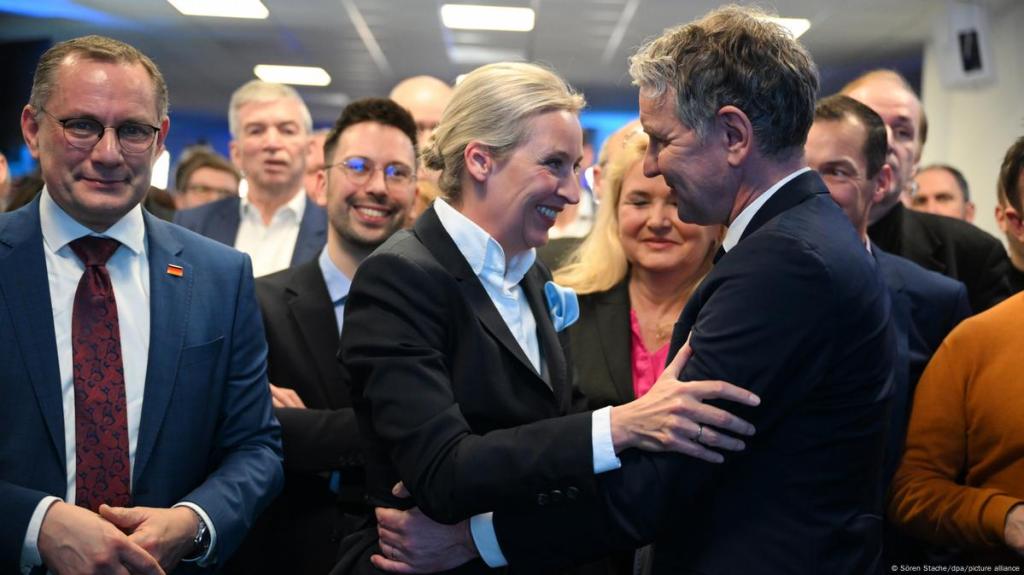
The German domestic intelligence agency Bundesamt für Verfassungsschutz (BfV), translated into English as “The Federal Office for the Protection of the Constitution,” made an official designation of the far-right party Alternative für Deutschland (AfD) as extremist on May 3, 2025.
This ruling is the result of the BfV labeling AfD as a suspected extremist party, viewing it as a threat to the German Constitution and the nation’s democracy exactly four years prior. However, due to an immediate and successful lawsuit developed by the far-right party to appeal the BfV’s decision, AfD’s official designation as a German extremist party has been halted.
With AfD gaining political traction in the German federal parliament, the Bundestag, AfD’s autonomy and influence in the German government are increasing. This is a very interesting time in the German government, with a suspected extremist party claiming the second-most seats in the 2025 German federal election. However, more than anything, the success of AfD’s appeal to BfV’s decision to suspend its official designation as an extremist party has implications for Germany’s shrinking threshold regarding its discernment of extremism.
Nazism’s Persistent Presence
Germany has a world-renowned history of extremism. Nazism is seen as the pinnacle of extremism in Germany, regarding obvious anti-Semitic themes and undeniable hatred towards the party’s out-groups.1 Although Germans have worked hard in the post-World War II era to eradicate anti-Semitism and the pursuit of an Aryan race, there have been instances in which these themes have been revived by AfD in public statements and Bundestag speeches.
For example, Björn Höcke, the chair of AfD’s Thuringia branch, has been fined by the state court of Halle for his usage of Nazi slogans not once, but on two separate occasions. In July 2024, the court fined Höcke and AfD €16,900 for chanting “Everything for Germany” during an event hosted by AfD in December 2023, a slogan famously used by the Nazi Sturmabteilung (SA), otherwise known as the Nazi Stormtroopers. Höcke denied any association of the chant with the SA, however, his statement lacked substance due to this being the second occurrence. He was also fined in May 2024 by the same court for the usage of this chant in an AfD campaign event in May 2021.
Another controversial statement from AfD considered to be a reflection of Nazi themes was by Maximilian Krah, the party’s top candidate in the European Parliament election in 2024. On the social media platform X in June 2023, in reference to the issue of immigration and Islamization in Germany, Krah posted about the concept of “Umvolkung,” and that “When #AfD points this out, it’s called a ‘right-wing extremist conspiracy theory.’ No, it’s real, and only the AfD is preventing it!”
“Umvolkung” is a term used in Nazi ideology pertaining to the fear of ‘Germans being gradually replaced by minor, Untermensch, or subhuman races.’
Remarkably, this issue has extended itself to other nations around the world as well, with extremism becoming a major controversy stirring in the United States. In January 2024, during the post-inauguration celebration for President Donald Trump, Senior Advisor Elon Musk made a gesture that some observers said resembled the Nazi salute. By first touching his heart and then stretching his right arm straight out to the crowd, Musk made a gesture closely resembling the Nazi gesture made to pay respect to the leader of the Nazi Party, Adolf Hitler.
Several political analysts have debated whether or not this was an intentional Nazi gesture, with Musk himself denying any association with the traditional Nazi salute. However, he has boldly expressed his unwavering support for AfD regardless of the party’s controversial history by declaring in a livestream alongside Alice Weidel, “Only AfD can save Germany, end of story, and people really need to get behind AfD, and otherwise things are going to get very, very much worse in Germany.” While it can be debated whether Musk meant to make a Nazi salute at Trump’s post-inauguration celebration, Musk’s denial seems suspect in light of his obvious support and admiration for the right-wing AfD.
Anti-Immigration and the Eradication of Islam
Along with AfD’s affinity to Nazi slogans and themes, the party has also developed a narrative about itself in which it requires that de-Islamization must occur throughout Germany. The shared opinion revolving around this issue within the party is that Muslim immigrants hold no value in society and jeopardize the security of Germany.
The party’s core belief on anti-immigration originates from the former chairwoman of AfD, Frauke Petry, following the 2015 refugee crisis in Europe. In the course of a year, roughly a million migrants entered Germany, fueling Petry’s vocal disapproval for the state’s measures to mitigate this issue. She successfully constructed the party as a channel of resentment for Germans feeling personally affected by a surge in immigration, and following AfD’s rise due to its success in mobilizing and rallying around this issue, the party began to fare well in following elections.
This opinion is officially documented through its “Manifesto for Germany,” published during its 2017 campaign in the German federal election. This manifesto outlines the party’s aspirations for Germany pertaining to its security, economy, and general welfare. In section 7.6.1 of its manifesto, the party boldly proclaims that “Islam does not belong to Germany,” and expands on this to emphasize that the religion’s “expansion and the ever-increasing number of Muslims in the country are viewed by the AfD as a danger to our state, our society, and our values.” In the following section, 7.6.2, AfD outlines the constitutional justification for criticism of Islam, stating that “The criticism of religion, which also applies to Islam, is legitimate within the legal framework, as it is part of the basic right of freedom of opinion.” AfD has emphasized this core belief in the Bundestag and in public rallies.
In May 2018, AfD co-chairwoman Alice Weidel declared in a Bundestag speech that “burqas, headscarf girls, publicly-supported knifemen, and other good-for-nothings will not secure our prosperity, economic growth, and the social state.” As the face of AfD, Weidel does not shy away from bold and controversial statements in regard to the party’s view on Islamization in Germany.
In May 2017, AfD officially appeared in a joint demonstration with PEGIDA in Dresden, Germany. PEGIDA, otherwise known as the Patriotic Europeans Against the Islamization of the Occident, is an organization predominantly characterized as a far-right populist/extremist organization determined to end the flow of Muslim immigrants into Germany. The organization is founded by Lutz Bachmann, a former criminal who was fined in April 2016 for using hate speech against Muslims and refugees. PEGIDA has repeatedly rejected the label of being a far-right extremist group, however, its rallies and marches are known to be very welcoming to neo-Nazis.
Rise in AfD’s Political Power and Influence
Regardless of the controversy surrounding the party, AfD has seen a recent substantial rise in its German federal election results. In 2017, the party had its initial moment of growth, gaining 12.6% of the seats in the Bundestag. In the 2021 election, AfD experienced a loss in the vote share gaining only 10.4% of the seats, however, the party has exponentially risen in the 2025 election by gaining 20.8% of the seats in the Bundestag, claiming the second-highest position in the German federal parliament.
Considering all of this, the question still stands: What does the successful result of AfD’s appeal to BfV for its designation as an extremist party imply for Germany’s threshold regarding its determination of extremism?
AfD has positioned itself in the past decade as a prominent German party. It has overtaken parties that have previously dominated the federal election such as SDP (Social Democratic Party of Germany) and Alliance 90/The Greens.
AfD’s Appeal and its Implications
With this increase in power, AfD is subject to even more scrutiny by the BfV in order to ensure that extremism is denied its opportunity to proliferate. However, it is evident that by successfully appealing for the suspension of its designation as an extremist party, AfD has exposed a certain measure of complacency in Germany pertaining to the potential return of extremism dating back to its peak in the 1930s and early 1940s.
As stated before, this is a very interesting moment in German political history. A party that has been previously suspected as an extremist party by the state’s domestic intelligence agency is continuing to develop its platform throughout Germany.
Although it is safe to say that a complete revival of Nazi Germany and an extremist government conforming to the standards of Hitler’s reign will not go unchecked by global powers, AfD continues to immerse itself in Nazi rhetoric and assume an extreme anti-immigration stance to appeal to its loyal constituency. As long as AfD does not cross the line into violent opposition and blatant support for Nazi ideals, it will continue to prance over political and legal roadblocks such as federal elections and civil fines.
- Berger, J. M. (John M.). (2018). Extremism. The MIT Press. (Noted to define out-group as a group that threatens either the success or survivability of an in-group by means of a crisis narrative such as impurity, existential threat, apocalypse, etc.) ↩︎
 The Diplomatic Drift
Leave a comment